
India’s industrial wastewater challenge is substantial: CPCB has previously estimated around 11,000 MLD of wastewater from 17 categories of medium and large industries alone. A wastewater treatment plant protects receiving water bodies by removing contaminants before discharge or reuse. In Indian factories, that usually means some combination of ETP, biological treatment, tertiary polishing, recycling, and, where required, Zero Liquid Discharge (ZLD).
Table of Contents
ToggleWhat Is a Wastewater Treatment Plant?
A wastewater treatment plant is an engineered system that removes physical, chemical, and biological pollutants from wastewater so the treated water can meet discharge or reuse requirements. In an industrial setting, the treatment train is selected around the actual effluent profile, not a generic plant template.
ETP vs. STP vs. CETP: Key Differences
| Treatment System | What It Treats | Common Applications |
| ETP | Industrial process effluent containing chemicals, oils, metals, colour,r or high COD | Textiles, pharmaceuticals, chemicals, food processing |
| STP | Domestic sewage from toilets, kitchens and staff facilities | Factories, commercial facilities, townships |
| CETP | Effluent collected from multiple industrial units | Industrial estates and clusters of smaller industries |
Normally, textiles, pharmaceuticals, chemicals, food processing, and metal finishing industries require an effluent treatment plant (ETP), while factories producing domestic effluent systems need an STP.
Why Indian Industries Need Wastewater Treatment?
One of the factors is compliance. Another factor is water security. India is home to approximately 18% of the global population with just about 4% of the world’s water resources; therefore, it is necessary to treat and reuse water efficiently for industrial progress.
Industrial discharge is regulated under the Water Act, 1974, the Environment (Protection) Act, 1986, sector standards, and SPCB/PCC consent conditions. CPCB also requires online monitoring for 17 highly polluting industry categories. Poor treatment can mean regulatory action, production disruption, and higher freshwater dependence.
How a Wastewater Treatment Plant Works: Step by Step
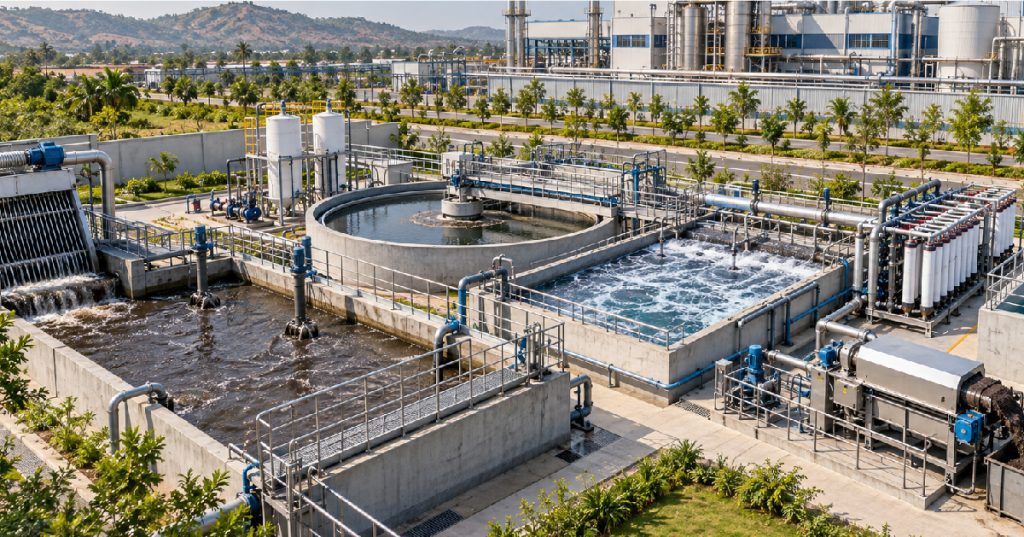
Most industrial ETPs follow four connected treatment stages. The exact wastewater treatment process changes with the industry, but the logic remains consistent: remove coarse material, separate suspended contaminants, biologically reduce organics, then polish the water for discharge or reuse.
- Preliminary → 2. Primary → 3. Secondary → 4. Tertiary
Stage 1: Preliminary Treatment
Unprocessed discharge travels via bar screens, strainers, or sludge chambers to get rid of plastic, fibers, sand, and other heavy waste that might harm the pumps. Equalization may even out the flow rate, pH, and pollutant load.
Stage 2: Primary Treatment
Coagulation and flocculation are methods of bringing together tiny particles to make larger ones that are known as flocs by using agents like alum and ferric salts, and polyelectrolytes. Oils and grease and other suspended debris are also eliminated using lamella settlers or clarifiers before biological treatment is performed.
Stage 3: Secondary Biological Treatment
This is often the heart of industrial wastewater treatment. Microorganisms consume biodegradable organic matter, reducing BOD and COD. Common approaches include Activated Sludge Process (ASP), Moving Bed Biofilm Reactor (MBBR), and Sequencing Batch Reactor (SBR).
Performance depends on influent quality, oxygen transfer, nutrient balance,e and sludge age; returned sludge is recirculated where the process design requires it.
Stage 4: Tertiary Treatment and Advanced Polishing
Tertiary treatment readies the water for stricter recycling conditions. Various techniques like Pressure sand filters, Activated carbon filters, Disinfection, ultrafiltration, and Reverse Osmosis are utilized.
The desired quality is determined by what it will be used for, say cooling-tower makeup, boiler-feed preparation, or process reuse. IS 10500 refers to a drinking-water standard, but is not considered an industrial reuse standard.
Key Wastewater Treatment Technologies Used in India
Modern wastewater treatment technologies are selected around contaminant type, footprint, recovery target, and lifecycle cost.
MBR combines biology with membrane separation for compact, high-quality treatment. MBBR uses biofilm carriers; SBR treats wastewater in timed cycles. Multiple Effect Evaporators (MEE) concentrate high-TDS reject streams, ion exchange resin systems polish dissolved ions, and electrocoagulation can address selected difficult contaminants.
Zero Liquid Discharge: Beyond Conventional ETP
A zero liquid discharge system surpasses traditional systems in that it enables water reclamation and transforms the remaining concentrated waste into a solid or semi-solid matter. Standard ZLD solutions make use of pretreatment and biological treatment when needed, UF/RO, evaporation, and crystallization.
The authorities have urged applying ZLD technology in many environmentally harmful industries and for the purposes in the Ganga River basin. The systems can also restore reusable salts or by-products.
Industry-Wise Wastewater Treatment in India
Textiles must manage colour, salts and high COD; pharmaceuticals may face complex organics and APIs; food processing typically has high biodegradable loads.
Chemical and petrochemical plants may need oil separation, precipitation and membranes, while tanneries require control of chromium, sulphides and salinity. Each industrial wastewater treatment plant should be based on actual wastewater characterisation rather than copied from another site.
Sludge Management: The Overlooked Part of ETP
After primary and biological treatment, the resultant sludge has to be concentrated, filtered through a filter press or centrifuge into a solid, collected, and removed safely in a legally acceptable manner. If sludge management is neglected, problems arise with odour, storage,e and compliance issues.
In other words, a complete effluent treatment plant (ETP) does not simply treat water. It also needs a properly engineered solids-management line.
How to Choose the Right ETP for Your Industry?
Commence with the characterization of wastewater and a study of its treatability. Consider the variation in flow measurements, BOD, COD, TSS, TDS, oil and grease, metals, nutrients, pH, and industry-specific pollutants. Then identify the capacity, reuse target, footprint, level of automation, and future expansion plans.
Don’t size ETP based only on average flow or assumed BOD. Peak flows highlight the weaknesses of designs, and the engineering requirements change drastically with increasing capacity and reuse goals.
Regulatory Compliance and CPCB Norms for ETPs
Indian industries must comply with applicable consent conditions and discharge standards under the Water Act and Environment (Protection) framework. CPCB has directed the 17 highly polluting categories to install OCEMS and connect monitoring data to regulators.
Following amendments effective April 2024, the Environment (Protection) Act uses monetary penalties for many contraventions; companies can face ₹1 lakh to ₹15 lakh per contravention plus daily penalties for continuing violations. The draft Liquid Waste Management Rules, 2024 also point toward stronger treatment and reuse accountability.
Compliance, therefore, is not simply an environmental checklist. For an operating plant, it is closely tied to production continuity and long-term business risk.
Latest Trends in Industrial Wastewater Treatment
The next generation of industrial wastewater treatment is increasingly digital and recovery-led. AI-supported monitoring, digital twins and predictive operations can help operators detect performance drift before it becomes a compliance event. Ion Exchange, for example, offers IonSite Digital Twin for water, wastewater, recycle, and ZLD assets.
Other trends include decentralised treatment, forward osmosis for high-salinity streams and advanced oxidation. Ion Exchange also offers forward-osmosis technology for challenging industrial wastewater and ZLD applications.
A 2022 Frost & Sullivan estimate cited by the U.S. International Trade Administration projected the Indian water and wastewater treatment market from USD 1.31 billion in 2020 to USD 2.08 billion by 2025, a 9.7% CAGR.
Ion Exchange for Industrial Wastewater Treatment
Ion Exchange has a long history of more than sixty years in the field of water management and has combined its expertise with the processes of wastewater treatment of waste water, recycling, membrane systems, advanced oxidation, evaporation, and capabilities of ZLD. It has the whole range of products,s from MBR systems and UF and RO membranes, advanced oxidation technologies, sludge management systems, to digital plant optimisation.
This integrated approach provides the treatment solution in accordance with the entire water balance, thus enabling the industry to reduce freshwater intake and enhance recovery. Instead of treating ETP as a separate compliance resource, it is possible to combine treatment, recycling and production into one water management approach.
Final Takeaway: Clean Water Starts with the Right Treatment Partner
A wastewater treatment plant is no longer simply a pollution-control asset. For Indian industry, it is part of water security, operational continuity and resource efficiency. The right solution starts with accurate wastewater data, the right treatment sequence, and realistic reuse targets.
Ion Exchange’s industrial water treatment solutions can support projects ranging from conventional ETPs to advanced recycle and ZLD systems. For a new plant or an upgrade, speaking with a treatment specialist before finalising the process design can prevent expensive corrections later.
Frequently Asked Questions
What is the difference between ETP and STP?
ETP is used to treat industrial process effluent, while the STP is used to treat domestic sewage. The designs of the two are different because industrial effluent has a variety of contaminants, which include chemicals, metals, oil, salt, and others.
Is a wastewater treatment plant mandatory for industries in India?
Industries have to comply with discharge standards and consent conditions. Whether an industry needs an ETP, a connection to a CETP, or uses any other approved arrangement will depend on the nature of the industry, characteristics of the effluent, its location, and regulatory requirements.
What is Zero Liquid Discharge in wastewater treatment?
ZLD is a treatment approach designed to eliminate liquid effluent discharge by recovering water for reuse and concentrating residual contaminants into solids or concentrated waste for appropriate management.
How much does an industrial ETP plant cost in India?
There is no reliable one-price answer. Cost depends on capacity, influent chemistry, treatment technology, automation, civil works, sludge handling, and required discharge or reuse quality. A treatability study is the right starting point for realistic budgeting.
What are the stages of an effluent treatment plant?
A typical wastewater treatment process includes preliminary treatment, primary physical-chemical treatment, secondary biological treatment, and tertiary polishing. Advanced plants may add UF, RO, evaporation,n or crystallisation for higher recovery or ZLD.