
Selecting the right sewage treatment plant manufacturers is essential for industries, commercial buildings, institutions, hotels, hospitals, residential complexes, and municipalities that need reliable wastewater treatment.
A well-designed sewage treatment plant helps reduce pollution, meet discharge standards, support treated-water reuse, and lower dependence on freshwater. However, plant performance depends on wastewater characteristics, treatment technology, system design, automation, and after-sales support.
The best STP manufacturers in India provide customised systems that meet the required water quality, available space, operating cost, and reuse objectives of each facility.
Table of Contents
ToggleWhat Is a Sewage Treatment Plant?
A sewage treatment plant removes organic matter, suspended solids, nutrients, and microorganisms from wastewater generated by toilets, kitchens, washrooms, and other domestic activities.
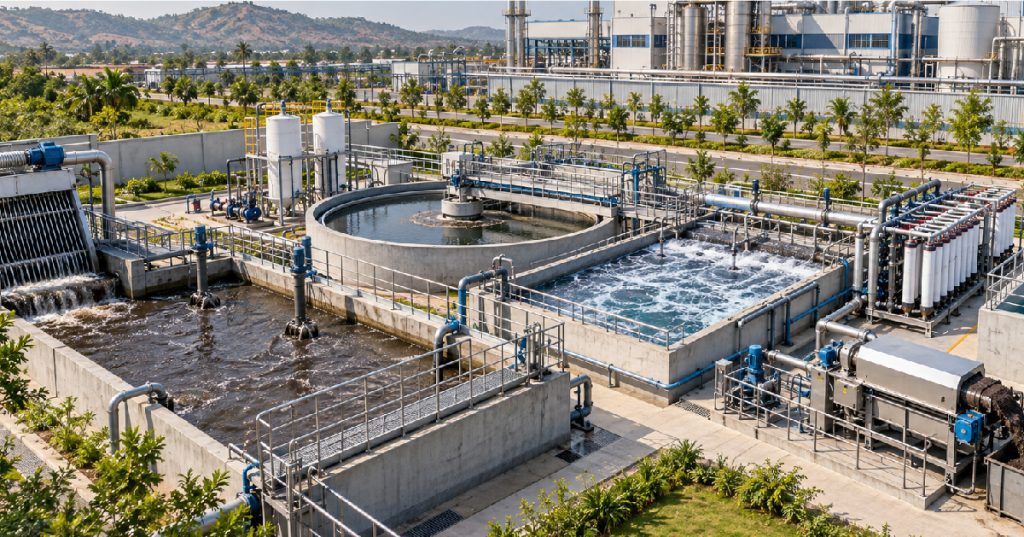
A typical sewage treatment plant in India may include:
- Screening and grit removal
- Equalisation
- Biological treatment
- Solid-liquid separation
- Filtration
- Disinfection
- Sludge handling
The treated water can be discharged according to applicable standards or reused for toilet flushing, gardening, cooling towers, cleaning, and construction.
Technologies Used in Sewage Treatment Plants
Different treatment technologies are selected according to wastewater flow, inlet quality, available space, and desired treated-water quality.
Membrane Bioreactor
A membrane bioreactor combines biological treatment with membrane filtration. It produces high-quality treated water within a compact footprint and is suitable where water reuse is important.
Moving Bed Biofilm Reactor
MBBR systems use plastic media that support biological growth. They are compact, easy to operate, and suitable for varying sewage loads.
Sequencing Batch Reactor
SBR technology performs biological treatment, settling, and decanting within the same reactor. It provides automated operation and consistent treated-water quality.
Fluidised Media Reactor
FMR systems use fluidised biological media to treat sewage within a compact tank. They are suitable for hotels, hospitals, residential complexes, and commercial facilities with limited space.
How to Select the Best STP Manufacturer in India?
The right manufacturer should be selected based on more than the initial equipment price.
Experience and Technical Expertise
Experienced wastewater treatment plant manufacturers understand how sewage flow, organic load, operating hours, and reuse requirements affect plant design.
They should recommend the technology based on actual wastewater conditions rather than offering one standard system for every application.
Customised Plant Design
Sewage characteristics differ across industries and facilities. A hotel, hospital, residential complex, and industrial unit may generate wastewater with different flow and contaminant levels.
The STP should therefore be designed according to:
- Daily sewage generation
- Peak flow
- BOD and COD levels
- Available area
- Required outlet quality
- Treated-water reuse
- Sludge disposal requirements
Compliance with Discharge Standards
The manufacturer should design the system to meet applicable pollution control and local discharge requirements.
Reliable treatment helps facilities avoid penalties, complaints, operational restrictions, and environmental risks.
Energy and Operating Efficiency
Operating cost is influenced by aeration, pumps, chemicals, sludge handling, manpower, and maintenance.
The best manufacturers select efficient equipment, automation, and treatment processes that reduce energy consumption while maintaining stable performance.
Automation and Monitoring
PLC-based controls, online monitoring, alarms, and automated operation improve treatment consistency.
Automation also helps operators track flow, dissolved oxygen, pressure, equipment condition, and treated-water quality.
Operation and Maintenance Support
Even a well-designed treatment plant requires regular monitoring and maintenance.
Manufacturers should provide:
- Plant commissioning
- Operator training
- Preventive maintenance
- Spare parts
- Process troubleshooting
- Membrane and media support
- Annual maintenance services
Strong lifecycle support helps maintain plant performance after installation.
Sewage Treatment Plants for Different Industries
The treatment system must match the application and wastewater characteristics.
Residential and Commercial Complexes
STPs treat sewage from toilets, kitchens, and common areas. Treated water can be reused for flushing, gardening, and cleaning.
Hotels and Resorts
Hotels generate sewage from guest rooms, restaurants, kitchens, laundry areas, and recreation facilities. Compact and low-odour systems are preferred.
Hospitals
Hospital sewage may contain high organic loads, cleaning chemicals, and microorganisms. The system may require additional disinfection and careful process control.
Educational Institutions
Schools, colleges, and campuses need systems that can manage variable wastewater flow during operating hours and holidays.
Industrial Facilities
Industrial premises generate domestic sewage as well as process effluent. Sewage and industrial effluent may require separate treatment systems.
Leading effluent treatment plant manufacturers evaluate the process wastewater independently and provide suitable ETP and industrial STP systems.
Municipal Applications
Municipal sewage treatment plants handle larger wastewater volumes and may include advanced biological treatment, nutrient removal, disinfection, and water-reuse systems.
Benefits of Choosing the Right STP Manufacturer
A properly designed sewage treatment plant provides:
- Reliable compliance with discharge requirements
- Lower freshwater consumption through reuse
- Reduced environmental pollution
- Lower tanker-water dependency
- Consistent treated-water quality
- Reduced odour and sludge problems
- Lower lifecycle operating cost
- Better plant reliability
Selecting the right manufacturer also ensures that the system can manage future changes in flow, occupancy, or treatment requirements.
Ion Exchange Sewage Treatment Solutions
Ion Exchange provides sewage and wastewater treatment solutions for industries, municipalities, institutions, hotels, hospitals, commercial developments, and residential complexes.
Its treatment portfolio includes advanced MBR, SBR, MBBR, FMR, and packaged sewage treatment technologies designed according to wastewater quality, plant capacity, available footprint, and reuse requirements.
Ion Exchange also provides pretreatment, filtration, disinfection, sludge management, reverse osmosis, automation, operation and maintenance, and plant-upgradation services.
Its industrial STP systems help facilities produce treated water for cooling tower makeup, toilet flushing, landscaping, cleaning, construction, and other non-potable applications.
With complete support from design and engineering to commissioning and lifecycle services, Ion Exchange helps customers maintain reliable plant performance and improve long-term water efficiency.
Conclusion
Choosing among the best sewage treatment plant manufacturers in India requires evaluating technology, customisation, compliance, energy efficiency, automation, and after-sales service.
The right manufacturer should provide a treatment system designed around the actual sewage characteristics and required reuse application rather than relying on a standard plant configuration.
A reliable sewage treatment plant not only meets environmental requirements but also converts wastewater into a reusable water resource.
Connect with Ion Exchange experts for customised sewage treatment plants, industrial wastewater systems, treated-water recycling solutions, and complete operation and maintenance support.
FAQs
What does a sewage treatment plant do?
A sewage treatment plant removes organic matter, suspended solids, nutrients, and microorganisms from domestic wastewater before discharge or reuse.
Which sewage treatment technology is best?
The right technology depends on sewage flow, inlet quality, available space, operating cost, and treated-water requirements. MBR, SBR, MBBR, and FMR systems are commonly used.
How do I select the best STP manufacturer in India?
Consider the manufacturer’s experience, treatment technology, customisation capability, compliance knowledge, automation, energy efficiency, and after-sales support.
Can treated sewage water be reused?
Yes. Properly treated sewage can be reused for toilet flushing, gardening, cooling towers, cleaning, construction, and other approved non-potable applications.
What is the difference between an STP and an ETP?
An STP treats domestic sewage from toilets, kitchens, and washrooms, while an ETP treats industrial process wastewater containing chemicals, oils, metals, or other industry-specific contaminants.