
Growing urban populations are increasing the demand for safe drinking water, putting pressure on existing water treatment plants to deliver more water without major infrastructure expansion.
For plants operating in space-constrained locations, building new treatment units may require significant land, construction, and infrastructure investment. Upgrading existing clarification systems can provide an alternative approach.
Ion Exchange’s Ultra High Rate Clarifier technology offers a compact approach to increasing clarification capacity within an existing water treatment plant. The technology integrates mixing, flocculation, and sedimentation in a single treatment basin, enabling higher-rate clarification without requiring additional land.
Table of Contents
ToggleWhy Do Water Treatment Plants Need Modernisation?
Many existing water treatment plants were designed for earlier population and water-demand levels. As demand increases, plants may need to handle higher flows while maintaining treated-water quality.
Common challenges include:
- Limited land for expansion
- Increasing raw water turbidity
- Existing clarifiers operating near capacity
- Higher demand for treated water
- Need to maintain consistent clarification performance
In such situations, a water treatment plant upgrade can provide an opportunity to increase capacity using existing infrastructure.
Rather than constructing additional clarification basins, high-rate clarification technology can be integrated into existing treatment infrastructure where technically feasible.
What Is Ultra High Rate Clarifier Technology?
Ultra High Rate Clarifier (UHRC) technology is a high-rate clarification process designed to intensify mixing, flocculation, and sedimentation.
The INDION UHRC integrates these three stages within a single treatment basin.
The technology uses solid contact clarification. Previously formed precipitates come into contact with incoming water and help accelerate chemical reactions, resulting in denser sludge particles that settle more rapidly.
This allows greater clarification capacity within a relatively compact footprint.
How Does Ion Exchange UHRC Technology Work?
The UHRC process combines three important clarification functions.
Mixing
Chemicals are rapidly mixed with incoming raw water to initiate the treatment reactions.
Flocculation
The water is then conditioned to promote the formation and growth of flocks.
Sedimentation
The formed particles settle rapidly, separating treated water from concentrated sludge.
By integrating these processes within one treatment basin, the UHRC system enables high-rate clarification while making use of existing plant infrastructure.
How Does UHRC Technology Upgrade Existing Water Treatment Plants?
A major advantage of the technology is its potential to increase treatment capacity without requiring additional land.
The Haiderpur Water Treatment Plant in Delhi provides a documented example.
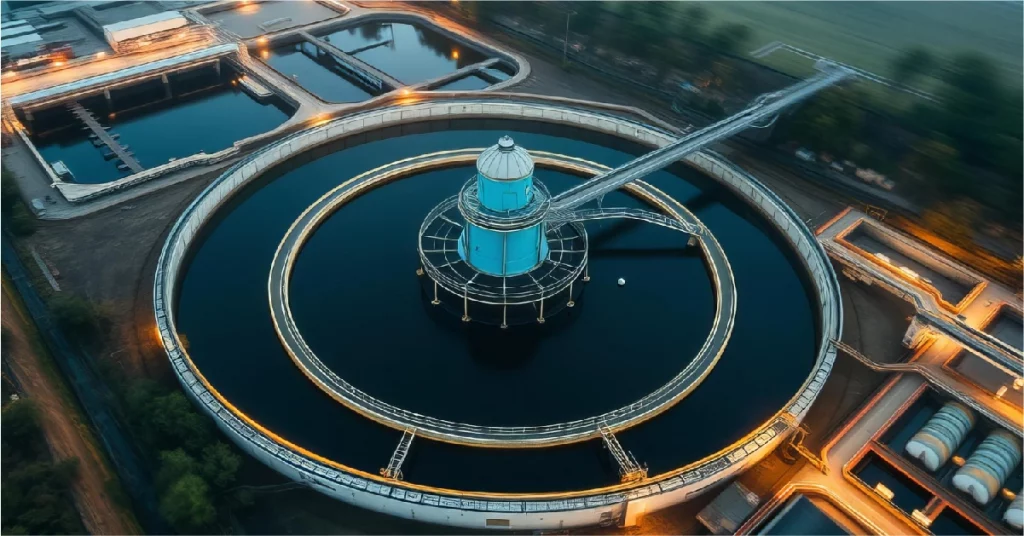
The plant has 16 existing Clari-flocculators, each 52 metres in diameter, with an existing capacity of 12.5 MGD. Ion Exchange upgraded the system through electro-mechanical modifications within the existing site. Following the upgrade, the capacity of each Clari-flocculator increased to more than 22 MGD.
The project demonstrated that existing clarification infrastructure can be upgraded to handle significantly higher treatment loads without expanding the plant footprint.
Key Benefits of UHRC Technology
Higher Treatment Capacity
Ion Exchange’s Haiderpur project demonstrated a more than 75 percent increase in Clariflocculator capacity, with the capacity increasing from 12.5 MGD to more than 22 MGD per unit.
No Additional Land Requirement
The Haiderpur capacity enhancement was achieved through electro-mechanical modifications within the existing site, eliminating the need for land expansion.
This is particularly relevant for water treatment plants located in densely developed urban areas.
High-Rate Clarification
The integrated mixing, flocculation, and sedimentation process enables faster settling of dense sludge particles and supports higher clarification rates.
Ability to Handle High Turbidity
Following the Haiderpur upgrade, the plant could handle inlet raw water turbidity of up to 4000 ppm while achieving treated-water turbidity below 30 ppm.
Modernisation Without Complete Plant Replacement
Where existing infrastructure is suitable, UHRC technology provides an approach to modernising clarification capacity without replacing the complete water treatment plant.
UHRC Applications in Industrial Water Treatment
UHRC technology is also applicable to industrial raw water treatment requirements.
The supplied Ion Exchange material identifies the technology as a choice for raw water treatment in steel and power industries. A documented installation for Jindal Steel & Power involved a 500 m³/h UHRC with chemical dosing, electrical, and instrumentation work for treating river water to industrial water quality.
The same source notes that smaller footprint and uniform output quality despite fluctuations in feed suspended solids were among the factors influencing the selection of UHRC technology for this application.
When Should a Water Treatment Plant Consider an Upgrade?
An upgrade may be worth evaluating when an existing plant is experiencing:
Increasing Water Demand
If the existing clarification system is approaching its capacity, increasing throughput without constructing an entirely new plant can become an important consideration.
Limited Space
Urban water treatment plants may have little or no additional land available for expansion.
Changing Raw Water Conditions
Seasonal or source-water variations can increase turbidity and place additional pressure on conventional clarification systems.
Existing Infrastructure That Can Be Retrofitted
Where existing basins and supporting infrastructure are suitable, a retrofit-based approach may reduce the need for complete plant reconstruction.
A technical assessment is necessary to determine whether UHRC technology is suitable for a particular plant.
Factors to Consider Before Upgrading a Water Treatment Plant
A successful water treatment plant modernization project should begin with an assessment of the existing system.
Important considerations include:
Existing Clarifier Design
The dimensions, hydraulic configuration, structural condition, and operating performance of existing clarification units should be evaluated.
Raw Water Quality
Parameters such as turbidity, suspended solids, seasonal variations, and chemical characteristics influence the treatment design.
Required Capacity
The desired increase in water production should be established before selecting the upgrade configuration.
Treated Water Quality
The upgraded system should be designed around the required treated-water quality and downstream filtration requirements.
Available Infrastructure
Electrical, mechanical, chemical dosing, instrumentation, and control systems should be evaluated as part of the upgrade.
Ion Exchange UHRC Technology for Water Treatment Plant Upgrades
Ion Exchange has demonstrated the application of INDION UHRC technology for increasing the capacity of existing clarification infrastructure.
The Haiderpur WTP project is a key example. The plant’s combined capacity was 200 MGD or 900 MLD across two phases, and the UHRC intervention increased the capacity of individual clariflocculators by more than 75 percent through modifications within the existing site.
Ion Exchange’s UHRC solution integrates mixing, flocculation, and sedimentation while using solids contact clarification to promote rapid formation and settling of dense sludge particles.
The technology has also been applied to industrial raw water treatment, including steel-sector applications where compact footprint and consistent output quality were important considerations.
Conclusion
Upgrading an existing water treatment plant can be an effective way to address increasing capacity requirements when land and infrastructure expansion are challenging.
Ion Exchange’s UHRC technology provides a high-rate clarification approach that integrates mixing, flocculation, and sedimentation while enabling capacity enhancement within existing infrastructure.
The Haiderpur WTP upgrade demonstrates how the technology can significantly increase clarification capacity without additional land expansion.
Connect with Ion Exchange experts to assess your existing water treatment plant and evaluate whether UHRC technology can support capacity enhancement and modernization.
FAQs
What is UHRC technology in water treatment?
UHRC stands for Ultra High Rate Clarifier. It integrates mixing, flocculation, and sedimentation within a single treatment basin to provide high-rate clarification.
How does UHRC technology upgrade an existing water treatment plant?
UHRC technology can be integrated into suitable existing clarification infrastructure through modifications to the existing system, potentially increasing treatment capacity without requiring additional land.
What was the capacity increase achieved at Haiderpur WTP?
At Haiderpur WTP, Ion Exchange increased the capacity of each 12.5 MGD Clari-flocculator to more than 22 MGD, representing a capacity increase of more than 75 percent.
Can UHRC technology handle high raw water turbidity?
The upgraded Haiderpur WTP was able to handle inlet raw water turbidity of up to 4000 ppm and achieve treated-water turbidity below 30 ppm.
Is UHRC suitable for industrial water treatment?
UHRC technology has been applied for raw water treatment in industrial sectors including steel and power. Its suitability depends on the source-water characteristics, required capacity, existing infrastructure, and treatment objectives.