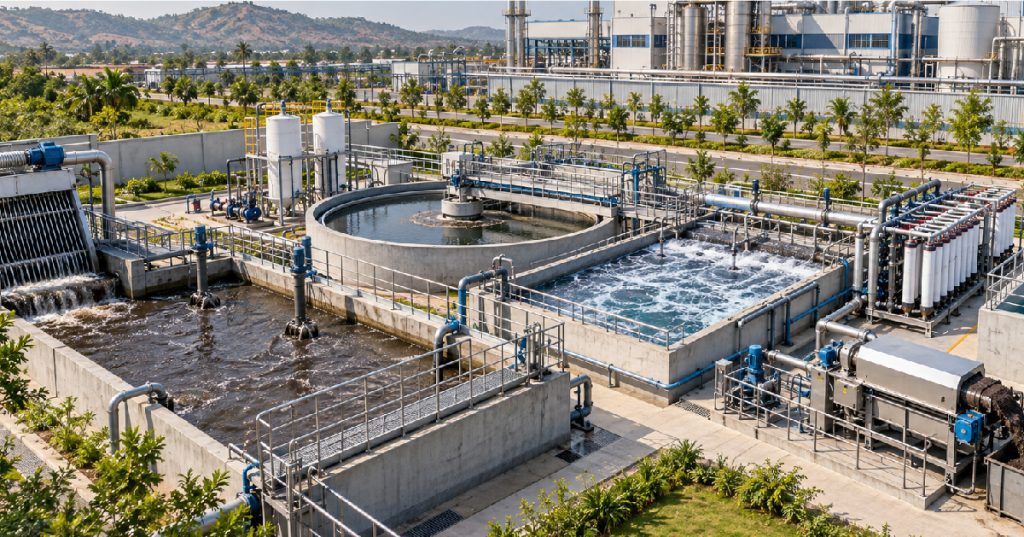

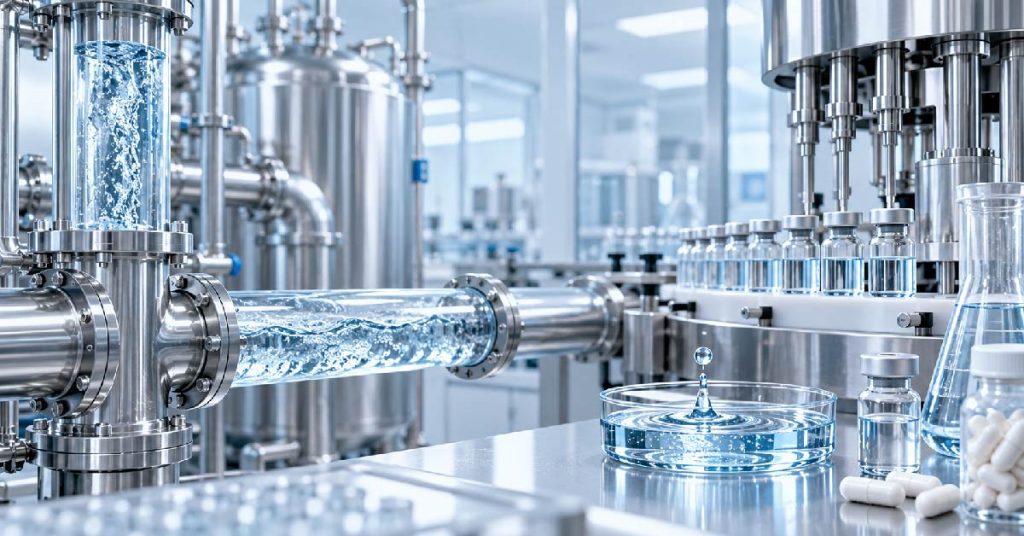
In pharmaceutical manufacturing, water is rarely just a utility. It can become part of a formulation, rinse product-contact equipment, support cleaning, or feed a more stringent purification stage.
That is why high-purity water must be treated as a controlled manufacturing input rather than simply “clean water.” What matters is not only the quality leaving the treatment skid but also whether that quality can be maintained through storage, distribution, sanitization, and use.
Table of Contents
ToggleWhat Is High Purity Water?
High-purity water is the water that has been subjected to a treatment process in order to eliminate dissolved salts, microbes, organic matter and particulates to a certain threshold, which corresponds to a specific critical application. The water purity level required varies depending on its intended use and relevant pharmacopoeial and GMP regulations.
The term covers a wide range of pharmaceuticals. The following types of water may be well known in pharmaceutical companies: Purified Water, Water for Injection (WFI). As defined by USP, Purified Water refers to water produced using an appropriate process from a drinking water source acceptable for the purpose of further pharmaceutical application, while WFI is produced using distillation or an equivalent treatment process (improving water quality to the level that is equal to or better than distillation).
Why Pharmaceutical Water Quality Needs More Than Purification
The purified water pharmaceutical industry challenge is not simply reaching a target once. The system must stay under control day after day.
Poor water quality and contamination can also create significant public-health risks, including waterborne diseases. Storage tanks, poorly designed piping, stagnant sections, and weak sanitization practices can undo good upstream treatment. FDA guidance therefore considers system design, validation, sampling, and ongoing operating control, not just treatment equipment.
This is where projects can go wrong. Teams sometimes specify equipment first and define the actual process requirement later. A stronger approach starts with risk: where will the water be used, what will it touch, and what happens if quality drifts?
Where Is HPW Used in the Pharmaceutical Industry?
The grade of water for pharmaceutical use should always match the application.
Purified water is commonly used for many non-sterile manufacturing processes, aqueous preparations, laboratory work, and cleaning applications where the relevant specification permits it. For example, FDA guidance refers to USP Purified Water for aqueous preparations and wet granulation.
Water for injection is used where a more stringent level of chemical, microbiological, and endotoxin control is needed. In sterile and parenteral manufacturing, WFI may be used in formulation and final rinsing of product-contact equipment or components, depending on the process. FDA guidance particularly highlights WFI where pyrogens are a concern.
Purified Water vs Water for Injection (WFI)
| Parameter | Purified Water | Water for Injection (WFI) |
| Typical use | Non-sterile manufacturing, cleaning, laboratory and aqueous preparations | Parenteral and other applications requiring tighter control |
| Purity requirement | High chemical and microbiological quality | More stringent control, including endotoxin requirements |
| Typical treatment | RO, ion exchange/electrodeionization and other suitable processes | Distillation or an equivalent qualified process, depending on applicable requirements |
| Selection | Based on the intended pharmaceutical application | Used where the process requires the higher level of control |
The practical lesson is important: select pharmaceutical-grade water by intended use, rather than assuming the highest grade is automatically the best answer. Over-specification can add unnecessary capital, energy, and sanitation costs. Under-specification can create a quality and compliance risk.
How Does a Pharmaceutical Water System Work?
There is no universal treatment train. A pharmaceutical water system should be designed around feed-water chemistry, required product-water quality, demand, microbial risk, sanitization philosophy, and distribution requirements.
A typical arrangement may use softening or filtration for pretreatment, reverse osmosis for broad contaminant reduction, and continuous electrodeionization for further ionic polishing. Demineralised water is also widely used where dissolved mineral ions need to be removed to achieve the required water quality.
The point is not to put as many technologies as possible on a process diagram. Each treatment stage should solve a defined problem. The design must also make sampling, cleaning, sanitization, monitoring, and maintenance practical. Water for pharmaceutical use needs to remain controlled after purification, not merely pass a test at one location.
What Ion Exchange’s INDION HPW System Adds
Ion Exchange’s INDION High Purity Water System embodies this combined strategy. According to its brochure, this system is a prevalidated solution specially crafted for pharmaceutical applications, which is a blend of an INDION water softener, microfiltration for preconditioning of the water supply, reverse osmosis, and continuous electrodeionization. Optional ultrafiltration technology is added to minimize endotoxins and bacteria, while optional UV technology assists in controlling microorganisms.
The system includes hot water sanitization, multi-level monitoring, stage sampling, programmable logic controller (PLC) controls, and packaged skid design.
According to Ion Exchange, the provided water reaches a resistivity of more than 18 megaohms-cm at 25 degrees Celsius, is characterized by total organic carbon (TOC) below 100 ppb, and has a total bacterial count of less than 10 CFU/100 ml. It should be noted that these values apply specifically to the system specified in the brochure and do not indicate that they can be applied to every pharmaceutical facility.
What Should Quality, Engineering, and Procurement Teams Check?
An agreement should be reached on the use, water grade and maximum demand, variation of feed water, effect of sanitizer on water, and loop design before a new or upgraded system is approved.
They must also look further than commissioning. Where will the samples be taken? How are you going to look at trends? What do you do when raw-water conditions change?
According to FDA guidance, the incoming quality of water is often subject to seasonal and external factors. Hence, a good design should account for practical feed-water variation and not use a single good lab sample.
From the standpoint of the purified water pharma industry, this view of the entire lifecycle may prove much more relevant than looking at a system in terms of an initial capital expenditure. These factors can have a more profound operational effect.
Ion Exchange as a Pharmaceutical Water Partner
Ion Exchange has been supplying water and wastewater treatment solutions to India since 1964, with engineered systems, membranes, ion exchange resins, treatment chemicals, and lifecycle services. Its pharma-grade resin manufacturing is based in a US-FDA-compliant and WHO-GMP-certified facility.
This broader ability gives pharmaceutical sites the option of taking a water purification perspective, in addition to wastewater treatment, reuse, utility optimization, and ultimate plant performance, rather than a single water issue approach.
Final Thoughts
High-purity water is critical to the manufacturing of pharmaceuticals, as it can affect process control, product quality, and compliance. The solution begins with understanding the application, choosing either Purified Water or Water for Injection (WFI), and arranging for treatment, storage, and distribution accordingly.
An effective system must do more than comply with the specifications on commissioning day. It must ensure compliance performance is repeatable.
Whether you are constructing a new pharmaceutical plant, upgrading your existing water purification equipment, or facing recurring challenges in sanitization or maintaining purity, get in touch with Ion Exchange experts to find a suitable solution for your processes, feed-water quality, and compliance requirements.
FAQs
1. What is high-purity water in pharmaceuticals?
It is highly treated water produced for pharma critical processes. The specifications for the chemical and microbiological quality of the water are based on its intended use and the standards to which it is produced.
2. What is the difference between purified water and WFI?
Purified water is used across many non-sterile pharmaceutical applications. WFI is used where tighter microbiological and endotoxin control is required, particularly in certain sterile and parenteral processes.
3. Which technologies are used to make pharmaceutical-grade water?
Common technologies include pretreatment, reverse osmosis, electrodeionization, UV, and ultrafiltration. The correct combination depends on feed-water characteristics and the required product-water specification.
4. Why does a pharmaceutical water system need validation?
Validation documentation evidences that the system is capable of manufacturing and distributing water of specified quality within the approved operating ranges.
5. Can one water purification system serve every pharmaceutical process?
Not necessarily. Different processes can require different grades and levels of control. System design should therefore follow intended use, product risk, and applicable pharmacopoeial requirements.