
India’s growing industrialization, urban expansion, and increasing water scarcity have accelerated the need for advanced wastewater treatment solutions. Industries and municipalities are now under pressure to reduce wastewater discharge, improve water reuse, and comply with stricter environmental regulations.
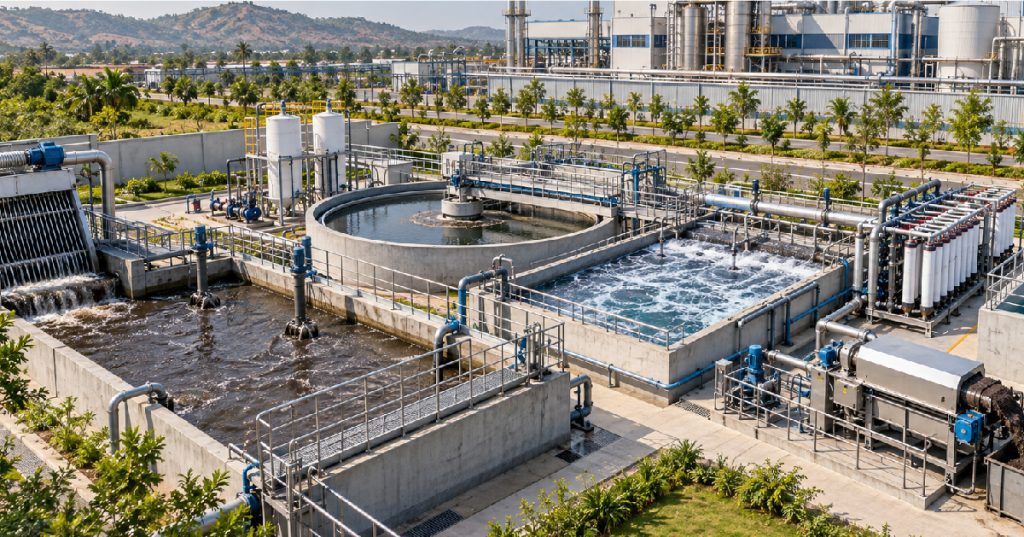
Among the most effective advanced wastewater treatment technologies India is adopting today is the Membrane Bioreactor (MBR) technology. By combining biological treatment with membrane filtration, MBR systems deliver high-quality treated water suitable for reuse in industrial, commercial, and municipal applications.
As industries move toward sustainable water management and recycling, MBR wastewater treatment plants are becoming a preferred solution across multiple sectors.
Table of Contents
ToggleWhat Is MBR Technology?
Membrane Bioreactor (MBR) technology is an advanced wastewater treatment process that combines:
- Biological treatment
- Membrane filtration
In conventional systems, treated water is separated from sludge using clarifiers. In an MBR system wastewater treatment setup, membrane filters replace traditional clarification units.
These membranes remove:
- Suspended solids
- Organic pollutants
- Bacteria
- Pathogens
- Fine particles
The result is highly purified treated water with significantly improved quality.
How the MBR Water Treatment Process Works?
The MBR water treatment process typically involves multiple stages.
1. Preliminary Treatment
Wastewater first passes through screening and grit removal systems to eliminate large particles and debris.
2. Biological Treatment
Microorganisms break down organic contaminants in aeration tanks.
This stage reduces:
- Biological Oxygen Demand (BOD)
- Chemical Oxygen Demand (COD)
- Organic pollutants
3. Membrane Filtration
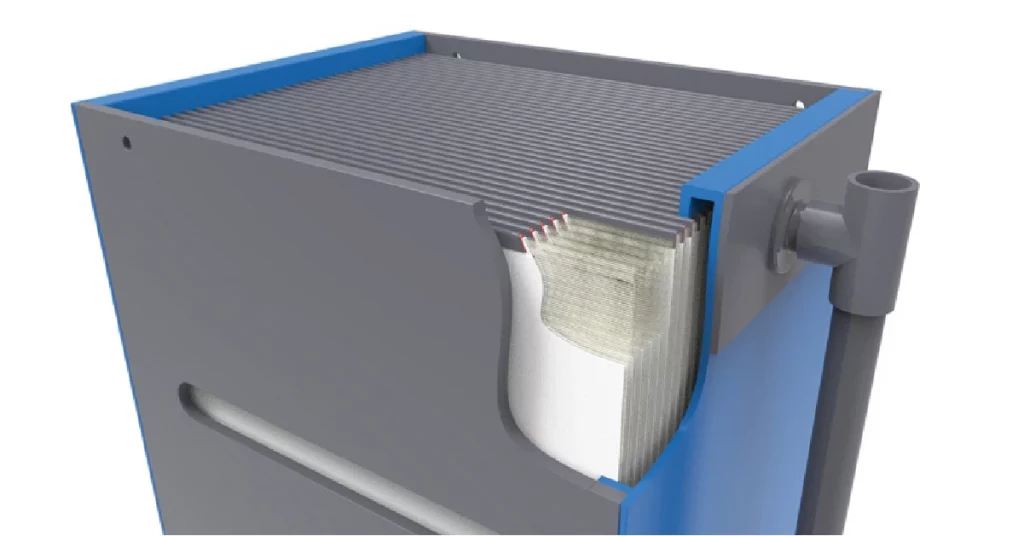
The biologically treated water passes through membrane modules that separate solids and microorganisms from the treated effluent.
The membranes provide excellent filtration efficiency and produce high-quality reusable water.
Why MBR Technology Is Growing Rapidly in India?
The adoption of membrane bioreactor technology in India is increasing due to several major factors.
Water Scarcity
Industries and cities are facing growing pressure to reduce freshwater consumption and increase water recycling.
Stricter Environmental Regulations
Pollution control norms are becoming stricter across industrial sectors.
Space Limitations
MBR systems require smaller footprints compared to conventional treatment plants.
Rising Demand for Water Reuse
High-quality treated water can be reused for:
- Cooling systems
- Boiler feed
- Landscaping
- Process applications
This makes MBR systems highly attractive for sustainable water management.
Benefits of MBR Technology
There are several important benefits of MBR technology compared to conventional wastewater treatment systems.
Superior Water Quality
MBR systems produce low-turbidity treated water with minimal suspended solids and pathogens.
Compact Plant Design
Because clarifiers are eliminated, MBR plants require less space.
Better Water Reuse Capability
The treated water quality is suitable for industrial reuse and recycling applications.
Improved Process Stability
MBR systems can handle fluctuating wastewater loads more efficiently.
Reduced Sludge Generation
Advanced biological treatment reduces excess sludge production.
Easier Compliance
MBR plants help industries meet stringent discharge and reuse standards.
Industrial Wastewater Treatment MBR Applications
Industrial wastewater treatment MBR systems are widely used across multiple sectors in India.
Pharmaceuticals
Require high-quality wastewater treatment due to complex chemical contaminants.
Food & Beverage
Use MBR systems for organic-rich wastewater and water reuse.
Textiles
Need advanced treatment for dye wastewater and recycling.
Chemicals & Petrochemicals
Use MBR systems to reduce pollutants before advanced polishing stages.
Commercial Infrastructure
Hotels, IT parks, malls, and airports use MBR systems for sewage recycling.
MBR vs Conventional Wastewater Treatment
Conventional Systems
- Require a larger land area
- Use clarifiers for separation
- Produce lower-quality treated water
MBR Systems
- Compact footprint
- Superior filtration quality
- Better reuse potential
- Lower suspended solids output
Because of these advantages, MBR wastewater treatment plants are increasingly replacing traditional treatment systems.
Role of MBR Technology in Water Recycling
One of the biggest advantages of MBR systems is their ability to support water reuse and recycling.
Treated water from MBR plants can be reused for:
- Cooling tower makeup
- Utility systems
- Process operations
- Landscaping
- Flushing applications
This significantly reduces freshwater demand and supports sustainability goals.
Challenges in MBR Wastewater Treatment Plants
Despite their advantages, MBR systems also require proper operational management.
Common considerations include:
- Membrane fouling management
- Energy consumption for aeration
- Membrane cleaning requirements
- Skilled operational monitoring
However, advances in membrane design and automation are continuously improving system efficiency.
Advanced Wastewater Treatment Technologies India Is Adopting
India is increasingly adopting integrated advanced wastewater treatment technologies alongside MBR systems.
These include:
- Reverse Osmosis (RO)
- Ultrafiltration (UF)
- Zero Liquid Discharge (ZLD)
- Advanced oxidation systems
- Smart monitoring and automation
Combined treatment solutions help industries maximize water recovery and reduce discharge.
Ion Exchange Solutions for MBR Wastewater Treatment
Ion Exchange provides advanced MBR wastewater treatment plant solutions for industrial and municipal applications across India.
Their solutions include:
- Industrial wastewater treatment MBR systems
- Sewage recycling plants
- Integrated membrane treatment systems
- Water reuse and recycling solutions
- Advanced wastewater treatment technologies in India
Using advanced membrane engineering and integrated treatment processes, Ion Exchange helps industries improve water recovery, reduce pollution, and support long-term environmental sustainability.
Conclusion
MBR technology is transforming wastewater treatment in India by enabling compact, efficient, and high-performance water recycling systems. With increasing focus on sustainability, compliance, and water reuse, membrane bioreactor technology in India is becoming an essential part of modern industrial and municipal infrastructure.
As industries in India continue to adopt advanced wastewater treatment technologies, MBR systems will play a critical role in improving water security and supporting sustainable growth.
FAQs
1. What is MBR technology in wastewater treatment?
MBR technology combines biological treatment with membrane filtration to produce high-quality treated wastewater.
2. What are the benefits of MBR technology?
MBR systems provide superior water quality, compact design, reduced sludge generation, and excellent water reuse capability.
3. Where are MBR wastewater treatment plants commonly used?
They are widely used in pharmaceuticals, textiles, food processing, commercial buildings, and municipal sewage treatment.
4. Can MBR-treated water be reused?
Yes, MBR-treated water is suitable for reuse in cooling systems, landscaping, flushing, and industrial applications.
5. How does Ion Exchange support MBR wastewater treatment solutions?
Ion Exchange provides integrated MBR systems, wastewater recycling plants, and advanced membrane treatment solutions for industrial and municipal applications.